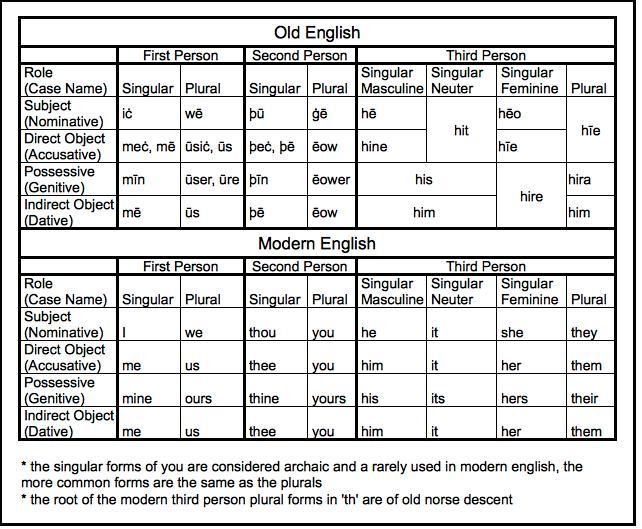
No, not a New Hope, that's not the correct order Mr. Lucas; but at least we have new grammar. Join me as we go over the basics of the Old English case system and learn why you can't just say "the" in Old English.
Check out this episode!
As promised, TABLES:
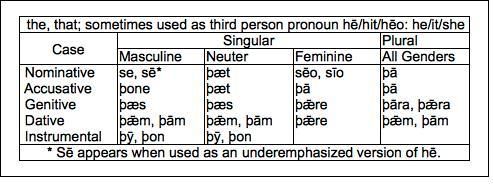
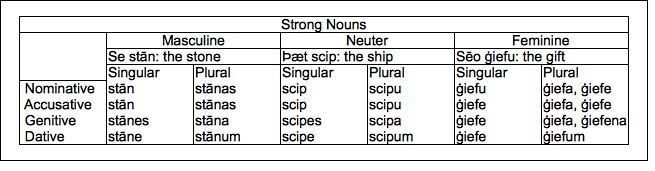
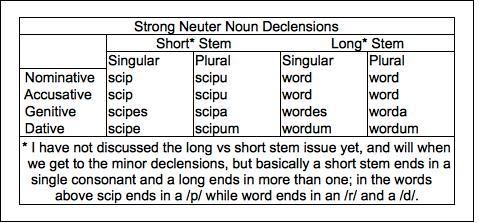

Se stān, þæt scip, þæt word, sēo ġiefu; þā stānas, þā scipu, þā word, þā ġiefa
Þone stān, þæt scip, þæt word, þā ġiefe; þā stānas, þā scipu, þā word, þā ġiefa
Þæs stānes, þæs scipes, þæs wordes, þǣre ġiefe; þā stāna, þā scipa, þā worda, þā ġiefena
Þǣm stāne, þǣm scipe, þǣm worde, þǣre ġiefe; þā stānum, þā scipum, þā wordum, þā ġiefum
Vocabulary
These are tagged with 4 in the Anki deck. I know it looks like a lot, but think of how similar some of them are to Modern English, also rest assured that there will not be new vocal until the next episode (around 2 week from now). Try creating your own sentences and adding more to your conversation. Don't worry too much about the different classes of strong verb yet, just know that that means they change their vowel in the preterite/past tense; along the same lines don't worry about the fact that adjectives have special endings, just put some sentences together and try it out.
Beswīcan - to ensnare, deceive Str. V. 1
Flēogan - to fly, take flight Str. V. 2
Breġdan - to braid, weave or knit Str. V. 3
Cweþan - to say, declare, or proclaim Str. V. 5
Ofslēan - to slay, destroy Str. V. 6
Slēan - to strike, beat, attack Str. V. 6
Bycgan - to buy Wk. V. 1
Ēhtan - to chase, pursue Wk. V. 1
Fēdan - to feed, sustain Wk. V. 1
Læċċan - to capture, sieze Wk. V. 1
Sellan - to give, trade, or sell Wk. V. 1
Temman - to tame Wk. V. 1
Wyrċan - to preform, work, or produce Wk. V. 1
Clipping - to call, summon, or cry out Wk. V. 2
Fandian - to tempt, test, or examine Wk. V. 2
Fremman - to make, accomplish, do Wk. V. 2
Ġeocian - to yoke Wk. V. 2
Lufian - to love, cherish Wk. V. 2
Lūtian - to lurk, sulk Wk. V. 2
Magan - to be able to, or competent Pret. Pres. V.
Witan - to know of, understand Pret. Pres. V.
Cwic - alive, living, quick Adj.
Dēore - dear, precious, beloved Adj.
Dēorwierþe - valuable, costly Adj.
Eald - old, ancient Adj.
Ġedyrtiġ - daring, bold Adj.
Ġehæp - happy Adj.
Ilca - same, the same as Adj. or Pron.
Lēas - devoid of, without Adj.
Māra - more, larger, bigger Adj.
Ōþer - other, another Adj. or Pron.
Til - good, apt, suitable Adj.
Se bāt - boat, ship Str. Masc. Noun
Se bēag - ring of precious metal either ornamental or valuable Str. Masc. Noun
Se Eald - elder, leader, prince Str. Masc. Noun
Se heofon - heaven, sky irreg. Masc. Noun
Se leax - lox, salmon Str. Masc. Noun
Se lenċten - spring (time of year), Lent Str. Masc. Noun
Se rǣd - advice Str. Mac. Noun
Se sleġe - a blow, strike, slaughter Str. Masc. Noun
Se feld - field u-stem Masc. Noun
Se sunu - son u-stem Masc. Noun
Se winter - winter (when counting years you count winters) u-stem Masc. Noun
Se angel - (fishing) hook Irreg. Masc. Noun
Se God - God, or god (mostly the Christian God) irreg. Masc. Noun
Sēo ċeasterwaru - a city dweller Str. Fem. Noun
Sēo ġiefu - gift Str. Fem. Noun
Sēo miht - power, strength, might Str. Fem. Noun
Sēo sunne - sun Wk. Fem. Noun
Þæt dēor - wild animal Str. Neut. Noun
Þæt folc - people, nation, folk Str. Neut. Noun
Þæt ġēar - year Str. Neut. Noun
Þæt land - land, soil, realm Str. Neut. Noun
Þæt nett - net Str. Neut. Noun
Þæt pleoh - danger, risk irreg. Neut. Noun
Būtan - without, except Prep.
Wiþ - against, from, in return for, with Prep.
Onġēan - back, again Adv.
Þearle - exceedingly, severely Adv.
Þā - then, when Adv.